Posts

Showing posts with the label Iranian regime

FATF and the checkmate situation of the Iranian regime

Image
The checkmate situation of the Iranian regime The Financial Action Task Force, the world’s de facto standards body on money laundering and combatting the financing of terrorism, issued a stark warning to the Iranian regime last week. “If by June 2019, Iran does not enact the remaining legislation in line with FATF Standards, then the FATF will require increased supervisory examination for branches and subsidiaries of financial institutions based in Iran. The FATF also expects Iran to continue to progress with enabling regulations and other amendments,” FATF’s public statement from February 22 reads. And so, the already controversial remaining FATF bills have entered new levels of inner quarrels between the ruling elite. Behzad Nabavi, former deputy speaker of the Majlis (parliament) and one of the iconic figures of the so-called reformist camp, warns rival conservatives about the consequences of not passing the FATF bills into law and says: “Not passing FATF will bring the...

A closer look at the Iranian regime’s nuclear program

Image
Iran's clandestine nuclear program The world powers and Iranian regime signed an accord on July 14, 2015, to put an end to more than a decade of tensions between western powers and Tehran over the mullahs’ clandestine nuclear program. The agreement, dubbed by some of its proponents as somewhat a historic deal, was to control and regulate the Iranian regime’s plans to become a nuclear power in return to yet to be fully disclosed rewards and incentives. The Obama administration and its former U.S. secretary of state John Kerry, the front line negotiator, made this agreement center focus of their Middle East policy by giving Iran even more concessions and leeway in the region. They literally viewed the deal as their legacy. However, as time passed and the public relations campaign and euphemism subsided, sober realities revealed a different picture about not only the deal, but also the parties involved. This particularly included the true intention of te Iranian regime for go...

MEK MEMBER BASHES FALSE CLAIM THAT SHE IS HELD HOSTAGE

Image
INU- The Iranian Regime and its cronies often try to paint their legitimate opposition, the People’s Mujahedin Organisation of Iran ( PMOI/MEK ), as a cult that brainwashes its members and refuses to let them leave their Albanian headquarters. Nothing could be further from the truth. Canadian-Iranian  Somayeh Mohammadi , a MEK member for over 20 years has spoken out about claims from her own parents that she is being kept at the MEK headquarters, named  Ashraf 3  after the group’s first camp near the Iran-Iraq border. Somayeh, 38, said: “When I wanted to leave Canada and join the [MEK] movement my parents (Mostafa and Mahboubeh) gave me their consent to do this.” But then, for some unknown reason, Mostafa changed his mind. Somayeh said: “[My dad] came many times in Iraq … around  Camp Ashraf  and installed 320 loudspeakers [through which they shouted abuse and played very loud music 24 hours a day]. My father was one of them. They threatened to kill all...

Who is Marzieh Hashemi, the Press TV anchor whose arrest has frustrated Iranian regime officials?

Image
Hashemi is reportedly an agent of Ministry of Intelligence and Security under the cover of a TV anchor Last week, an American-born TV anchor who was working for Iran’s state-run broadcasting channel was arrested by FBI when she landed at St. Louis Lambert International Airport in Missouri. Marzieh Hashemi, born Melanie Franklin of New Orleans, who is working for the English-language arm of Iranian regime’s state-run TV channel, graduated in broadcasting field in 1979, when the Iranian people overthrew Shah and Khomeini seized the power in Iran. Franklin then chose her pro-Khomeini husband’s family name, Hashemi. She converted to Khomeini’s extremist perversion Islam and became a radical supporter of Khomeini. “For me, embracing Islam is directly in relation to Islamic revolution of Iran and the characteristic of Imam Khomeini,” Hashemi told ESTEBSAR Iranian English state-run website on February 14, 2015. Hashemi has lived in Iran since 2008, where she became an anchor for Pres...

Why Europe's efforts to change the Iranian regime's behavior constantly fail

Image
Europe’s “special purpose vehicle” After the current U.S. administration pulled out of the flawed Iran nuclear deal, the European Union promised to the ruling theocracy in Iran to create a Special Purpose Vehicle to circumvent U.S. sanctions and allow the Iranian regime to continue selling its oil without repercussions. But while the end-2018 deadline for setting up the clearinghouse-like mechanism, has already passed, no European initiative has appeared on the horizon. Meanwhile, some European officials did their best to express their commitment to the Iran deal, also known as the Joint Comprehensive Plan of Action (JCPOA). In her personal blog, EU’s high representative for foreign relations and security policy Federica Mogherini published  an article  titled “Twelve things to bring with us in 2019” and described her efforts to rescue the deal by creating “a mechanism to let our [European] firms continue their legitimate business with Iran.” While the staunch su...

Azad University’s bus accident, another manifestation of the Iranian regime’s corruption and incompetency

Image
An accident involving one of the busses of Tehran's Azad University left 10 dead and dozens injured  On Tuesday, December 25, 2018, a bus carrying students from the Science and Research unit of Tehran’s Azad University veered off a steep, mountainous road and crashed into a cement block, causing the death of 10 passengers and injuring 28 others. This was an incident that could’ve been avoided, had the Iranian regime provided its universities with better vehicles and maintenance services. The Azad University incident is not a one-off incident. It’s the manifestation of the awful state of Iran’s roads as well as the substandard equipment of its universities, both the result of four decades of corruption and mismanagement at the highest levels of power in the mullahs’ regime. In October, Iran’s Channel One television reported, “According to statistics, there have been 7,000 road casualties since the beginning of the year.” Despite warnings, Iranian authorities haven’t t...

The Iranian regime has virtually collapsed

Image
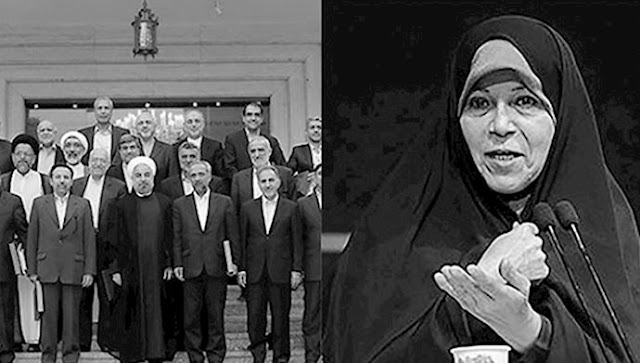
Faezeh Rafsanjani, the daughter of former Iranian regime president Ali Akbar Hashemi Rafsanjani  In an interview with Mostaghel, a state-run news outlet, Faezeh Rafsanjani, the daughter of former Iranian regime president Ali Akbar Hashemi Rafsanjani, stressed that the regime has collapsed in all but its outward appearance. “In my opinion, the collapse has already happened in content. It’s only in physical appearance that the collapse has not happened, and I deem it very probable that it will happen,” said Rafsanjani, who is also a former member of the Iranian regime’s parliament. Rafsanjani also admitted that despite the high tension between the people and the regime and the ongoing protests of all walks of life in Iran, the regime has only responded by arresting and imprisoning the protesters. “Presently, if you look at any domain, some of the activists of that domain are in prison, including workers, teachers, truck drivers, women’s rights activists and environmental act...

Iranian regime authorities are hard-pressed to answer their own questions

Image
Hard questions Warnings about the future of the Iranian regime are abundant among Iranian officials these days, while its state-run talks about the “danger of explosion,” the “poverty pit,” and “competency crisis.” Arman newspaper, close to the so-called moderate faction of regime president Hassan Rouhani, wrote on December 23: “Currently, only the private-public companies are working. Thus, many job opportunities are destroyed and socially, a powder keg is created that threatens to explode at any moment.” Public-private ( khosulati ) has become a  distinct word in the Persian  language which consists of the beginning of the word private and the end of the public. If it existed in the English language, it would be something like “prilic” or “pubate.” Thanks to the widespread corruption in the so-called privatization process of the formerly publicly owned companies in Iran, the media and opposition figures invented this word combination to better describe the situati...

Yet another example of business-as-usual scandals in the Iranian regime

Image
The Mafia Economy A few days after it was revealed that Iranian regime president Hassan Rouhani’s son-in-law was appointed to the head of a department in the industry, mine and trade ministry, he was forced to resign. The revelation caused an uproar in Iranian social media networks leading to more coverage by  English   media . Iranian media outlets, especially those close to Rouhani’s faction, stepped in to cover the mess and claimed that Hassan Rouhani was not aware of the appointment and that he nulled the decision immediately after he was informed. But the ridiculous claims were refuted which led to more disgrace. On December 16, Qassem Jasemi, an Iranian MP from Kermanshah province, said: “Mr. minister of industry and trade, instead of improving the industry, trade and mining of the country, you are seeking the president so that he introduces his son-in-law to you or that you introduce him unilaterally and when the whole story is revealed, they say that the p...

More isolation for the Iranian regime on the global and regional stages

Image
Iran regime are exporting terrorism While discontent and protests against the mullahs increase all over Iran, the international community and nations in the Middle East are increasingly distancing themselves from the ruling mullahs in Tehran. The December 12 United Nations Security Council meeting was a prime example of the growing concern among the international community regarding Iran. Many of member countries, including eight European countries, protested the Iranian ballistic missile program—especially expressing concern about its recent ballistic missiles test—and asked the regime to pay attention to their concerns and alleviate them. Earlier, in his report to the Security Council, United Nations Secretary-General António Guterres presented the discovery of Iranian-made rocket launchers in Yemen. But the Iranian ballistic missiles program isn’t the only source of concern for the international community and countries in the region. Currently, exported terrorism made ...