The World Will Be A Safer Place, Without State-Sponsors Of Terrorism

Unfortunately, we live in a world that the state-sponsors of terrorism threaten global peace and security. It is clear that terrorism reflects the corruption and deterioration of morality and humanity and alienation from the civilized world in the 21st century. There are governments that exploit terrorism as a device to silence dissidents. But in our era terrorism doesn’t stop at this stage.
The most well-known of the state-sponsors of terrorism
States-sponsors of terrorism defines governments that not only support terrorism but also use it as leverage to advance their foreign policies. They waste the national assets to fund this aim; instead of spending for people’s welfare. The most well-known of such states is the religious fascism ruling Iran, also known as the godfather of terrorism.
Though the Iranian regime was not listed by the US State Department on its list of “State-sponsors of terrorism” at first, it later became the number one state-sponsors of terrorism in the world. For the Mullahs, export of terrorism is a strategic policy called “the exportation of the revolution”.
IRGC; the most important device of the godfather of terrorism
In fact, they justify terrorism by abusing religious beliefs. They have assigned a special organ to pursue this policy, the “Islamic Revolutionary Guards Corps” It should be noted that the budget of the IRGC in 2018 alone was higher than the total budget of all other military organs or other suppressive organs such as the Basij Organization. This is why “It’s hard to find a conflict or a terrorist group in the Middle East that does not have Iran’s fingerprints all over it!” Nicky Haley said on December 14, 2017.
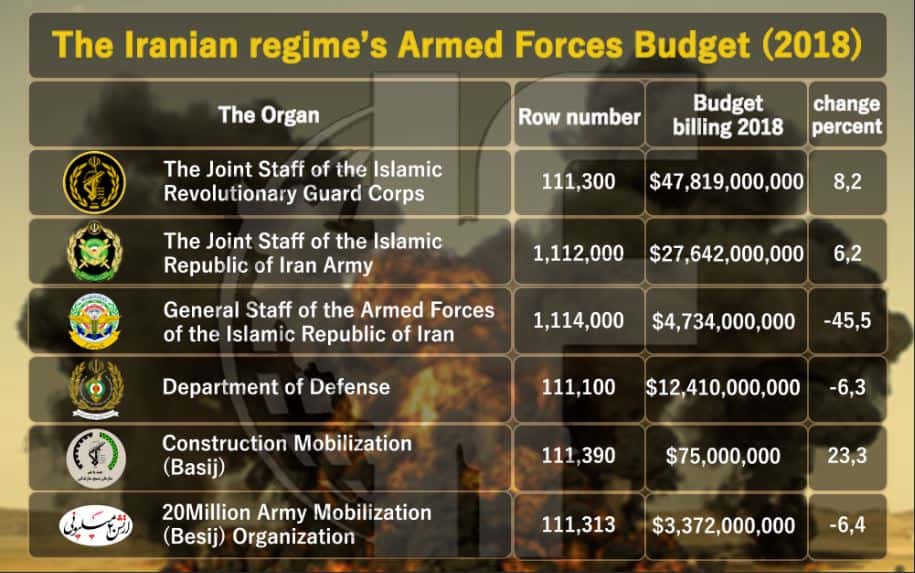
We must also mention the Qods Corps here. An organ affiliated with the IRGC and responsible for carrying out terror operations abroad. This force is under the command of Ghasem Soleimani, who is currently in terror list of US. Ghasem Soleimani is known for his massacre in Syria, the purge of Sunnis in Iraq, and etc.
In addition to supporting terrorism and training them, the mullahs’ regime also conducts terrorist operations. If the political price of carrying out such operation is high, they use their opposition as their scapegoat, accusing it of the act.
To mention a few of such acts in the Middle East only we can name: Transport of explosives planted to Mecca in Hajj pilgrims’ baggage in 1987; carrying cold weapons by regime’s elements during Hajj ceremony in 1988 which created a chaos with 402 dead in Mecca, the most holy Muslim city; the explosion of the Shia’s eight Imam’s Shrine in Mashhad, Iran, on June 20, 1994. And Samarra’s explosion in Iraq to ignite Sectarian war on February 2006. Gen. George Casey, Commanding General, Multi-National Force, Iraq (2004 to 2007) disclosed the role of the preeminent of the state-sponsors of terrorism in that crime.
And during 2018, we were also witnessed:
– Terrorist plot against the MEK/PMOI in Albania on March 2018,
– An attempt for a terrorist blast at the annual meeting of the Iranian resistance in France on June 30, 2018,
– Spying and terrorist project against the Iranian resistance’s members in the on August 2018,
– The missile attack on Iranian Kurdish parties on September 2018,
– And the assassination plot in Denmark,
– An attempt for a terrorist blast at the annual meeting of the Iranian resistance in France on June 30, 2018,
– Spying and terrorist project against the Iranian resistance’s members in the on August 2018,
– The missile attack on Iranian Kurdish parties on September 2018,
– And the assassination plot in Denmark,
The geopolitical scope of the terrorist acts of the regime can be found from the AMIA blast in Argentina to the assassination of Iranians in Switzerland, Italy, France, Germany and Turkey, targeting and killing American soldiers in the Middle East, as well as the missile attacks on MEK/PMOI camps in Iraq, and the assassination of prominent figures in the Middle East and even the failed assassination of the Saudi ambassador in Washington.
But the question is why the mullahs cannot stop their export of terrorism?
Firstly, the dictatorship of the Velayat-e-Faqih is in the hope of bringing its dream of forming a religious empire into reality by exporting its revolution (read terrorism).
Secondly, while mullahs became much weaker both inside and abroad, they resort to terrorism as a factor of survival. So, in 2018, as the uprising of the people against the regime in its entirety rose, we witnessed the rise of its terrorist acts, especially against its opposition;
It should be noted that these actions have severely damaged the regime’s relations with Europe.
But what is the solution?
In fact, the solution is that the mullahs must change their provocative and warmongering behavior. But, as such behavior is in the Velayat-e-faqih’s
nature with a dream of forming an empire this would just be a mirage.
nature with a dream of forming an empire this would just be a mirage.
Change in behavior for the most known state-sponsors of terrorism, which bayonets its own people in implementing its rules, equals its end. Khamenei himself admitted on May 10, 2018, “There is no difference between regime change and changing behavior”
As a result, when the mullahs are not willing to change their behavior, so they must go. This is the fact that the MEK and the organized Iranian resistance have discovered 37 years ago. They are known as the arch-enemy of the mullahs, 120,000 of their members have been executed by this regime. The mullahs fear them and want to restrict them. They are the subject of all the regime’s negotiations.
So the solution is very simple: to recognize the Iranian people’s just struggle and the Iranian resistance. A rightful struggle that led by NCRI’s president-elect, Maryam Rajavi. She is properly the harbinger of the Iranian people’s freedom and peace, and coexistence in the Middle East.


Comments
Post a Comment